
AI Solutions
WhatsApp Bot vs AI Chatbot for Small Business in India (2026)
Weps Technologies · 20/11/2026 · Updated 20/11/2026
Should your Indian business use quick replies, a rule-based WhatsApp bot or an AI chatbot? Compare features, Meta's 2026 charges, customer handoff and rollout steps.
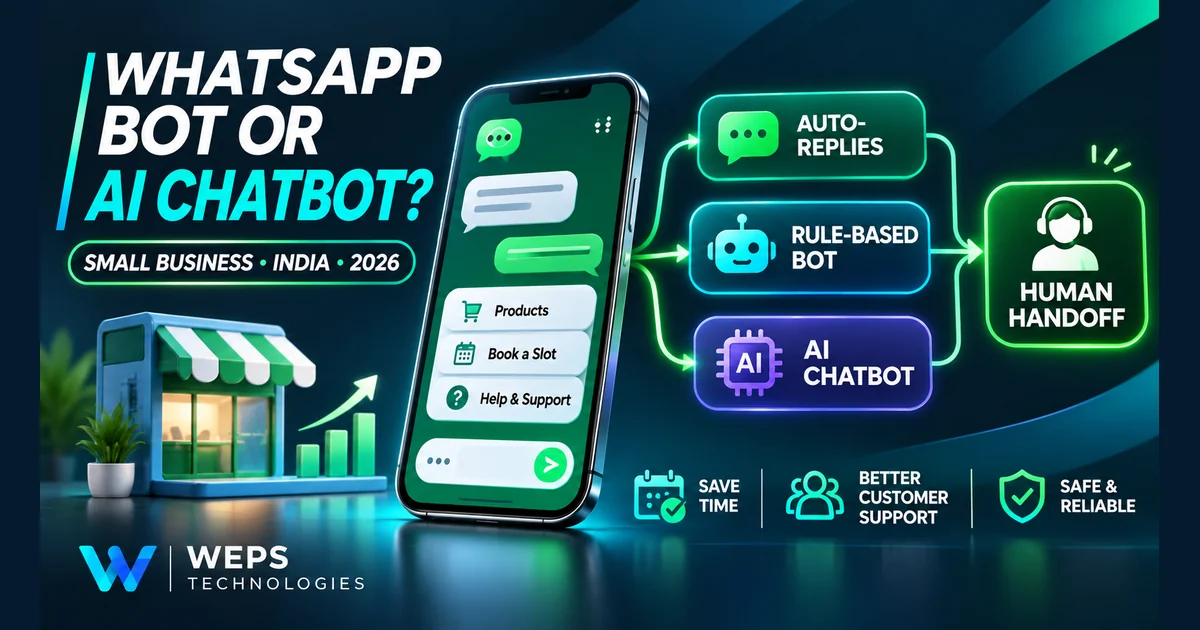
Quick answer: Start with the least complex option that reliably resolves real customer questions. For low message volumes, the WhatsApp Business app may be enough: greeting messages, away messages and saved quick replies. For repeatable steps such as choosing a product, checking an order or booking a slot, consider a rule-based WhatsApp bot on the WhatsApp Business Platform. For varied questions that genuinely need language understanding, add an AI chatbot grounded in your approved business information, with an easy way to reach a person. None of these tools replaces human judgment for refunds, disputes or sensitive decisions.
An important distinction: WhatsApp is the channel; rule-based or AI describes how the automation answers. An AI chatbot can run inside WhatsApp using an eligible business integration. You are not choosing between WhatsApp and AI; you are choosing the level of automation and who handles exceptions.
This India-focused guide explains the choices, gives a practical comparison, covers Meta's October 2026 pricing changes, and helps you brief a vendor without buying software you do not need. For help assessing a specific workflow, see WEPS Technologies' AI solutions.
Three options — in plain English
Option 1: WhatsApp Business app, quick replies and auto-replies
The WhatsApp Business mobile app is usually the simplest starting point for a neighbourhood store, solo professional or new service business. You can configure a greeting, an away message and saved quick replies that a person selects while chatting. These features are different from a fully automated, multi-step bot. They typically require no API integration or custom development.
Good for: a small team, limited message volume, a consistent price list or opening hours, and customers who benefit from a fast human reply.
Watch for: staff availability, missed chats, inconsistent answers and the time required to respond manually. Do not assume saved quick replies mean every question is answered automatically.
Option 2: Rule-based WhatsApp chatbot
A rule-based bot follows a controlled flow. For example: 1. Browse products → 2. Ask about delivery → 3. Talk to a person. On the WhatsApp Business Platform, eligible integrations can use interactive buttons or lists, account data and a human-agent inbox.
Good for: order lookup, appointment intake, lead qualification, store information and simple support menus, provided the underlying data and integrations are available.
Watch for: complicated menus, stale information, inaccessible buttons and customers who do not see a relevant choice. Always include a route to a person.
Option 3: AI chatbot with business-approved answers
An AI chatbot uses language understanding to interpret natural messages — including potentially Hindi and Hinglish — and generate helpful responses. It should retrieve facts from an up-to-date, approved knowledge source instead of inventing stock, prices, delivery promises or refund policies. It still needs restricted permissions, evaluations, logging and a human override.
Good for: customers who describe the same need in many different ways, a moderately large but maintainable information base, or multi-step explanation that is hard to cover with a fixed menu.
Watch for: plausible but false answers, uncertain intent, private data, recurring model costs, inaccurate translations and automation that keeps talking when it should escalate.
Comparison: rule-based WhatsApp bot vs AI chatbot
| Decision factor | Rule-based bot | AI chatbot |
|---|---|---|
| How it responds | Predefined rules, buttons or workflows | Generates responses using approved instructions and content |
| Strength | Predictable answers to known questions | More flexible language and free-text handling |
| Weakness | Customers get stuck when the flow misses their need | Wrong or unsupported answers can sound convincing |
| Hindi/Hinglish | Possible with written multilingual flows | Possible but needs multilingual evaluation |
| Order or booking status | Good when connected to a verified API | Should call the same trusted API, not guess |
| Maintenance | Update scripts, menus and integrations | Update content, safeguards, model configuration and tests |
| Human handoff | Required when no menu fits | Required when uncertain, sensitive or requested |
| Best first project | Menu, lead intake, order-status flow | Narrow FAQ help after a scripted fallback exists |
A practical recommendation: Use a hybrid system where rules handle identity, consent, prices and transactional actions; AI handles approved explanations; and people handle exceptions. That reduces risk without forcing every customer into a rigid menu.
Which option fits your business? Four examples
These are illustrative workflows, not claims about delivered WEPS client projects.
| Business | Customer messages | Sensible starting point |
|---|---|---|
| Local retail shop | "Are you open?", "Do you deliver?", "Send catalogue" | Business app, then menu if volume grows |
| Clinic or appointment desk | Timings, available appointments, rescheduling | Rule-based booking intake plus staff confirmation; no automated medical advice |
| Hotel or homestay | Check-in, rooms, guest count, dates, property rules | Scripted lead capture and availability lookup; optional AI FAQ with human confirmation |
| E-commerce seller | Tracking, returns, sizes, delivery questions | Order API plus rules; AI for approved FAQs and human handling of disputes |
A hotel bot, for example, can ask for check-in and checkout dates, number of guests, room type and contact preference, then check live availability through an authorised booking system. It must never fabricate an available room or a confirmed reservation.
WhatsApp Business app vs Business Platform: different products, different costs
Do not confuse the WhatsApp Business mobile app with the WhatsApp Business Platform (API). The app provides small-business features directly on a phone. The Platform supports application integrations, multiple agents, templates and programmatic messaging through direct integration or a provider; it also has its own message pricing and policy obligations.
A business may also pay a provider for inbox software, automation, hosting, AI inference and setup. A quotation should separate Meta messaging fees, provider subscriptions, development/integration costs and ongoing maintenance.
The 24-hour customer service window
For the WhatsApp Business Platform, a message from the customer opens a 24-hour customer service window, reset by later customer messages. During that window, the business can send non-template service replies. Outside the window, business-initiated messages require an approved template, and appropriate user opt-in is necessary. An automated bot and a human agent must both follow these rules. Source: Meta pricing documentation, and see the WhatsApp Business Messaging Policy for opt-in rules.
What changed on 1 October 2026?
Important 2026 update: Meta began charging for WhatsApp Business Platform service messages beyond the first 1,000 delivered service messages per business phone number per month. The free allowance resets monthly and does not roll over. Utility template messages inside an open 24-hour window can also incur charges. Messages are also free while a Free Entry Point window is open: when a customer messages you from a Click to WhatsApp ad on the Android or iOS app and you reply inside the customer service window, Meta does not charge for messages in that window, which can stay open for up to 7 days. Rates depend on the destination market, message category and current Meta rate card; check those when preparing a real budget. This change applies to the Business Platform, not ordinary conversations in the standalone WhatsApp Business mobile app. Meta official pricing.
Illustration, not a quote: If one API-connected business number sends 1,200 delivered service replies in a month, the first 1,000 consume its free service-message allowance and the remaining 200 are potentially billable at the applicable Meta service rate. Other template messages, provider fees and AI inference costs are separate. This is a count illustration, not a statement of any current rupee tariff.
Do not copy outdated articles that say all service replies or all utility messages inside the customer window are free. Meta's older marketing pricing pages can still display such language; use the dated developer pricing documentation as the publishing reference.
Are general-purpose AI assistants allowed on WhatsApp?
Meta's terms, updated on 15 January 2026, say that providers of general-purpose AI assistants may offer them on the WhatsApp Business Platform only where Meta is legally required to permit it, as described on Meta's AI Providers pricing page. See also the WhatsApp Business Solution Terms. This is not the same as a business using AI incidentally for its own customer support. Check the current terms, your business use case and your provider's contract before deployment; do not treat an unrestricted chatbot as an approved default.
A 50-message exercise to choose without guessing
Before buying software, take 50 recent inbound customer messages (or as many as you have), remove personal details and classify each by intent: opening hours, product information, order status, booking, complaint, payment/refund or other. Then write down what a correct answer would require.
- Mostly repeated facts: keep the Business app or automate a short rule-based menu.
- Repeated transactions needing live data: connect a controlled workflow to the source system.
- Many varied but low-risk questions: test a grounded AI FAQ assistant with a confidence/fallback policy.
- Frequent disputes or sensitive requests: improve human response and routing before increasing automation.
Use an explicit success metric such as percentage resolved correctly without handoff, handoff speed, unsupported-answer rate and cost per resolved conversation. Counts alone — like how many messages a bot sends — are not proof of value.
Human handoff: design this before you launch
Every bot should let customers write "human", "agent" or tap Talk to a person without passing through extra menus. Add escalation when the customer asks for a human, the bot repeats itself, no approved source supports the answer, a payment/refund dispute arises or the conversation becomes sensitive.
A practical handoff record contains the intent, customer-approved contact details, last relevant messages, any verified order reference, and a short reason for escalation. Share only the data needed by the agent. Tell the customer actual support hours rather than promising an immediate response when nobody is available. Once an agent takes ownership, pause automated replies until the human explicitly closes or returns the conversation to automation.
For financial, legal or medical topics, a bot can collect non-sensitive logistical details and direct the customer to a qualified professional, but should not make a consequential decision or invent a professional judgment.
What the monthly budget should include
| Cost line | Questions to ask |
|---|---|
| Meta messaging | How many delivered service, utility, marketing and authentication messages by destination market? |
| Platform / BSP | Monthly inbox or automation fee? Any markup, minimum or additional agent seats? |
| Initial setup | Business verification, account connection, template creation, bot design and API integration? |
| AI runtime | Model/token charges, retrieval storage, evaluation and fallback costs? |
| Operations | Human support staff, content maintenance, monitoring, alerts and backups? |
| Compliance and privacy | Opt-in capture, retention, access controls, deletion and audit logging? |
Ask the vendor for a low-volume and high-volume scenario, plus a kill switch that returns the experience to a human inbox. Never choose on a single "AI bot price" that omits message delivery and operations.
A sensible 30-day pilot plan
Week 1 — Understand: Categorise real messages, choose one business outcome, verify data sources, confirm permissions and document the current human workflow.
Week 2 — Build narrowly: Configure greetings or one menu, create an approved FAQ list, add the human handoff button and connect only necessary read-only APIs.
Week 3 — Test: Run Hindi/Hinglish, ambiguous, malicious, out-of-hours and edge-case conversations. Check opt-in and template restrictions; do not test with real payment credentials.
Week 4 — Pilot and measure: Start with a limited audience, review failures with a named owner, compare automation results against the previous process and decide whether an AI layer is justified.
This is an illustrative pilot sequence, not a promised delivery timeline for any specific project.
Ten questions to ask a WhatsApp chatbot vendor
- Does your proposal use the WhatsApp Business app or the official Business Platform, and who controls the business account?
- Which customer questions will be answered automatically, and which will be escalated?
- Which approved data sources or APIs are used to answer prices, availability and order status?
- How do you handle Hindi, Hinglish and multilingual misunderstandings?
- Where is opt-in recorded, and how are opt-outs processed?
- How are service-message charges, template charges, provider fees and AI runtime separated?
- What happens when the AI cannot verify an answer, or a customer asks for a person?
- Can we see test results for inaccurate answers, security, handoff and failure recovery?
- Who owns conversation data, templates, integration code and the provider account, and how is it handed over?
- Can our team turn automation off immediately without losing the customer inbox?
Frequently asked questions
Is a WhatsApp bot the same as an AI chatbot?
No. WhatsApp is a messaging channel. A WhatsApp bot may be rule-based, AI-powered or hybrid. The choice is about the response logic and the human fallback, not the name of the app.
Is a rule-based bot always cheaper than AI?
Usually it is simpler for fixed tasks, but not automatically cheaper in every case. Compare integration effort, Meta charges, subscription and running support alongside any model fees.
Are WhatsApp Business API service messages free in India in 2026?
On the WhatsApp Business Platform, the first 1,000 delivered service messages per business phone number each month are free under the rules effective 1 October 2026; later service messages are charged at applicable rates. This is separate from standalone WhatsApp Business app features. Check Meta's current rate card before publication or budgeting.
Can a WhatsApp AI chatbot speak Hindi or Hinglish?
Many can, but quality depends on the system and your approved information. Test real Indian customer language, including mixed-script and short messages, before enabling unrestricted automated replies.
Can my bot send marketing messages to all old customers?
No. Businesses must meet WhatsApp's opt-in requirements and use appropriate approved templates for proactive or out-of-window messaging. Existing phone numbers are not permission to send unsolicited promotions.
Can AI confirm a hotel room or order refund automatically?
Only if your system has live verified data and an explicitly authorised action workflow. Otherwise, it should collect requirements and hand over to a staff member. Never let a language model invent inventory or payment approvals.
What happens when a bot gives a wrong answer?
Your process should log the case appropriately, stop repeating the unverified claim, route it to a human, fix the approved source or rule and retest before re-enabling that intent.
Discuss a practical AI support workflow with WEPS Technologies
If your business receives repetitive WhatsApp enquiries, start by sharing the top five question types, approximate daily volume and whether you already use a CRM or booking system. We can help decide whether a simple app setup, a scripted bot or an AI-assisted workflow is justified. See our AI solutions service or contact WEPS Technologies; you can also call or WhatsApp +91 97193 25253. We will not promise a specific sales uplift, platform approval or automation accuracy without scope and testing.
For a separate example of why AI needs narrow tasks and human review, see our guide to practical computer vision.
WEPS Technologies is independent and is not affiliated with WhatsApp or Meta. This article is a practical technology guide, not legal, regulatory or financial advice.
Official references and further reading
- Meta: WhatsApp Business Platform pricing, including October 2026 updates
- WhatsApp: Business Messaging Policy
- WhatsApp: Business Solution Terms and AI provider restrictions
- Meta: AI Providers pricing policy
- WhatsApp: Business mobile app
Policy, pricing and source links reviewed on 20 November 2026. Reconfirm before publishing or changing any automated messaging system.