
Mobile Apps
Mobile App Development Cost in India (2026): Budget Guide
Weps Technologies · 15/11/2026 · Updated 15/11/2026
What does it cost to build a mobile app in India? Compare published 2026 agency estimates, understand major cost drivers, and get a practical quotation checklist.
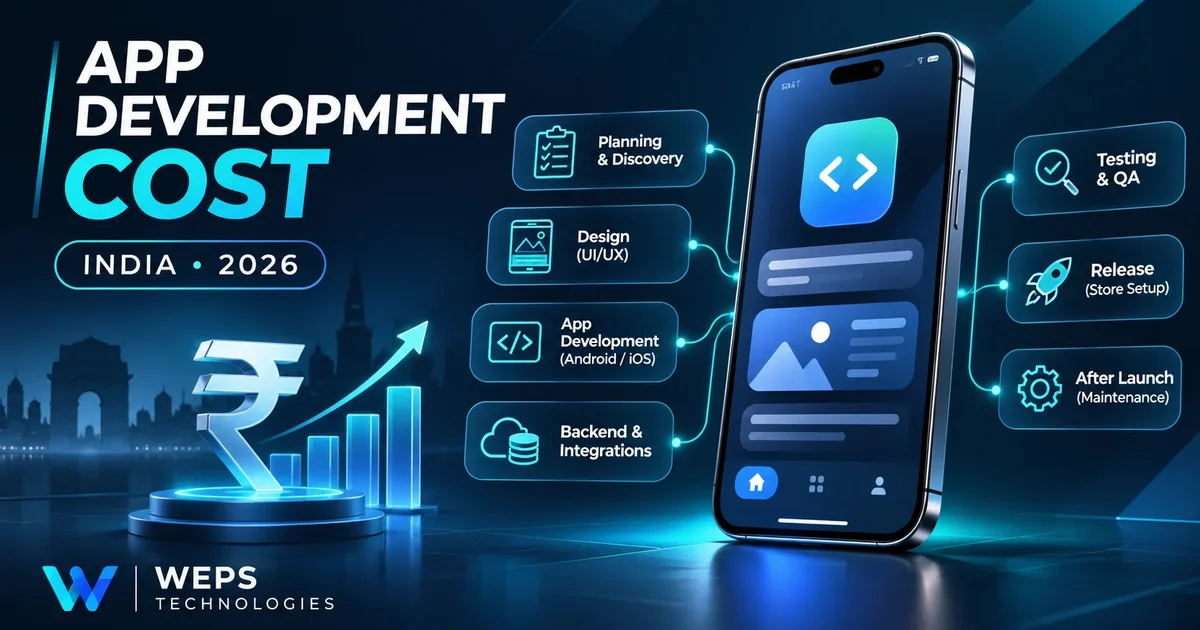
Quick answer: The cost of mobile app development in India is not one fixed number. As examples, Indian agencies publishing estimates in 2026 put simpler apps at roughly ₹2–8 lakh, medium-complexity business apps at ₹5–25 lakh, and complex platforms at ₹15 lakh to ₹50 lakh or more. These are overlapping examples drawn from different agencies' published ranges, not a representative market average, a guaranteed price, or a Weps Technologies price list. The number that matters is the cost of your defined scope, including design, backend, testing, release, ownership and support. Source: Approids · Source: Bright Infonet
If you are budgeting for an Android app, an iPhone app, or a shared Android/iOS product, start by deciding what the first usable release must actually do. Two quotes for “a booking app” can be radically different if one includes payment collection, an admin dashboard, SMS notifications and support while the other only delivers screens.
Weps Technologies does not publish a standard rate card. We provide scoped estimates after understanding the workflows and assumptions. The third-party ranges below are included to help readers assess budgets, not to advertise a Weps quotation.
How much does app development cost in India in 2026?
A useful way to understand market uncertainty is to compare what individual companies themselves publish instead of averaging unlike projects.
| Published 2026 guide | Lower-complexity app | Mid-complexity app | Complex platform |
|---|---|---|---|
| Approids | ₹2–5 lakh (simple MVP) | ₹5–15 lakh | ₹15–50 lakh+ (full platform) |
| Bright Infonet | ₹3–8 lakh | ₹8–25 lakh | ₹25 lakh+ |
How to read this table: These are individual agencies' published indicative bands as reviewed in November 2026. The categories, inclusions and assumptions differ; the figures are not audited transaction data and do not establish a reliable national average. A prototype, production app, admin dashboard and ongoing maintenance must not be compared as if they were identical deliverables. Ask every bidder to state the work included, tax treatment and support duration.
Examples of scope, not fixed-price packages
- Basic utility or focused MVP: A narrow core workflow, a small number of screens and limited integrations may fit a lower-complexity budget. An offline-first calculator and an account-based booking platform should not be treated as equivalent.
- Business app: Login, backend, admin access, notifications, maps and payment integration can move a product into a larger budget because more flows require design, security checks and testing.
- Marketplace or operations platform: Multiple user roles, live status, location, offline syncing, compliance, extensive integrations and high-reliability infrastructure usually require a phased delivery plan rather than a one-line fixed figure.
If your budget is limited, reduce first-release scope before removing testing or security work. Our application-planning guide shows how to separate essential user journeys from features that can wait.
What determines the cost of developing an app?
1. Android, iOS or both
A single-platform release can have less implementation and testing work than shipping on two platforms. A Flutter codebase may reuse UI and business logic, but native plugins, platform differences, payment flows, accessibility and store release still need attention. Deep camera, background processing and hardware integration can change which technology is suitable. Read our native Android vs Flutter comparison before assuming that shared code is automatically the cheapest option.
2. Features and user roles
A visitor browsing information differs from a customer signing in, an operator approving requests and an administrator resolving disputes. Roles, permissions, audit records, search, file uploads, approvals and payments increase the number of paths to develop and verify. A feature list is not enough: specify who can do what, when and with which data.
3. Backend, database and integrations
Backend work may include API design, authentication, database rules, admin tools, backups, notification delivery, fraud controls and monitoring. Payments, maps, SMS/OTP, ERP or CRM systems, and AI services can introduce ongoing vendor bills as well as build effort. Ask whether those charges are included or billed to your own account.
4. Design and accessibility
Reusable UI components and clear workflows usually cost less than elaborate interactions and fully bespoke animation. Even a modest app needs loading states, empty states, error recovery, readable text, meaningful touch targets and accessibility checks.
5. Security, offline use and compliance
Sensitive data, local encryption, role-based access, retention rules and consent workflows are architecture requirements, not finishing touches. Offline capture and background synchronization also require careful handling of retries, duplicates and conflicts. If regulated data is involved, request a compliance review appropriate to your business rather than treating this article as legal advice.
6. Testing, deployment and change requests
A credible quote includes real-device testing, API error cases, regression checks, app-store assets and deployment responsibility. A late change to an approved workflow can affect design, backend and testing together. Define a documented change-request process before work begins.
What should an app-development quotation include?
Use this breakdown to compare vendors line by line.
| Quotation line | Ask what the quote includes |
|---|---|
| Discovery | User journeys, assumptions, exclusions, requirements, acceptance criteria |
| UI/UX | Screen inventory, prototype, accessibility and revision rounds |
| Mobile app | Platforms, devices, modules, account roles, offline features |
| Backend | APIs, admin panel, database, authentication, integrations, environments |
| Quality assurance | Test cases, target devices, regression tests, bug-fix responsibility |
| Release | Google Play / App Store submission, listing assets, privacy declarations |
| Ownership and handover | Repository, documentation, store accounts, signing access, deployment instructions |
| Warranty and maintenance | Defect-fix window, monthly support scope, response times and excluded changes |
Important: Request milestone-based deliverables with acceptance criteria and confirm which party controls the developer accounts, cloud billing, API credentials and code repository. A cheap quote can become expensive if the project is not transferable after launch.
What costs come after the initial build?
Some charges are paid directly to third parties and should be shown separately from the development quotation.
- Google Play Console: Google's official documentation lists a one-time US$25 developer registration fee, subject to its eligibility, payment and verification requirements. Google Play Console
- Apple Developer Program: Apple lists US$99 per membership year, or local currency where available; enrollment rules and any applicable exemptions should be checked before paying. Apple Developer Program
- Hosting and infrastructure: Databases, storage, bandwidth, push-related services, monitoring and backups may vary with use.
- Paid integrations: SMS, email, payment gateway, map and AI services can use per-request, per-transaction or subscription pricing.
- Maintenance: OS changes, security updates, app-store policies, analytics, bug fixes and product enhancements continue after launch. Ask for a specific annual or monthly support proposal rather than assuming a universal percentage.
- Taxes and marketing: Confirm whether taxes, store listing assets, advertising and acquisition campaigns are inside or outside the budget.
For Android-specific release requirements, see our Google Play publishing checklist. Requirements change, so recheck official policy when you launch.
Native Android vs iOS vs Flutter: which is cheaper?
There is no universally cheapest framework. For an Android-first product that needs camera, background processing or specialized device APIs, native Kotlin can be a sensible first release. For an iPhone-first product, Swift and SwiftUI may be appropriate. Flutter can improve code reuse when most screens and logic are shared across platforms. Request estimates for the same scope, quality bar and release responsibilities; otherwise the comparison is misleading.
Weps Technologies works with Kotlin, Swift/SwiftUI and Flutter according to product constraints. Our mobile application development service explains those choices and the end-to-end delivery process.
A practical sample: calculating a first-release budget
Consider a hypothetical appointment-booking app, not a real Weps client quotation. Version one allows a customer to browse available slots and request a booking; an administrator accepts or rejects requests. The first estimate should specify whether the project also needs OTP sign-in, online payments, a provider portal, reminders, refund logic, analytics and multiple languages.
A transparent budget worksheet is:
Project budget = discovery + design + mobile development + backend/admin + QA/release + contingency + taxes
Year-one operating budget = hosting + paid APIs + developer-account fees (where applicable) + maintenance + marketing (if needed).
Use the worksheet to compare like-for-like scope. Do not copy a price from a different app category into your own budget without a technical review.
How long does a mobile app take to build?
Timeline and budget are related, but doubling features does not always double calendar time. Work may run in parallel, while approvals, integrations and store reviews can create delays. For perspective, our mobile-app development timeline guide discusses a focused MVP in roughly 2–4 months and larger custom apps in about 4–9 months or more as broad planning examples, not promises.
A milestone plan should show discovery, designs, development increments, QA, release readiness and post-launch support. Ask for dependencies and decision owners, not just an expected release date.
How to reduce app-development cost without reducing quality
- Define one measurable user outcome for the first release and keep a written list of non-goals.
- Choose the initial platform from your users and device requirements, not from a blanket technology claim.
- Reuse established components when custom interaction does not improve the core task.
- Specify integrations early, including API access, vendor pricing and support contacts.
- Agree on acceptance criteria and change control before development starts.
- Plan testing, privacy and release work from day one instead of treating them as extras.
Questions to send an app-development company before requesting a quote
Copy this short brief into your enquiry: Who is the main user? What must they accomplish? Which platform(s) do they use? What are the three essential features? Does a backend or website already exist? Which payment, SMS, map or other services are required? Who owns the developer accounts? What deadline or budget limit matters? The company can then identify the missing details before issuing an estimate.
Frequently asked questions
What is the cost of a basic Android app in India?
There is no universal basic-app price because an offline utility and an app with login and cloud data are different projects. As directional third-party examples, the 2026 Approids guide places simple MVPs at ₹2–5 lakh, while Bright Infonet places its simple-app band at ₹3–8 lakh. Verify scope, platform count and inclusions before using either figure for a budget.
What is the cost of an iOS app in India?
The cost depends on features, Apple-specific requirements, backend and testing. Ask for an iOS-only quote with the same scope used for your Android or cross-platform comparison. Apple's developer membership is a separate recurring charge.
Is Flutter app development always cheaper than native development?
No. Flutter may reduce duplicated code in a suitable two-platform project, but platform-specific hardware features, plugins, performance needs and QA can change the result. Compare written proposals for the same deliverables.
Does an app development quote include backend and maintenance?
Not automatically. Request explicit lines for API/backend, admin dashboard, cloud hosting, post-launch bug fixes and ongoing maintenance. A build-only quote is not a lifetime operating budget.
How do I get an accurate app development estimate?
Share the user journeys, key screens, target platforms, existing systems, required integrations and a first-release scope. Ask the vendor to provide written assumptions, exclusions, milestones, ownership terms and a support proposal.
Discuss your mobile app idea with Weps Technologies
Tell us what users need to do, the platforms you are considering and whether you already have a backend or prototype. We can respond with the scoping questions needed for a realistic written estimate. Explore our mobile application development services, use the project contact form, or WhatsApp +91 97193 25253. We do not promise a fixed cost before the scope is known.
Sources and pricing-method note
- Approids, How Much Does a Mobile App Cost in India in 2026? (2026 published agency estimates): https://www.approids.com/blog/mobile-app-cost-india-2026/
- Bright Infonet, App Development Cost in India: 2026 Guide (2026 published agency estimates): https://www.brightinfonet.com/insights/app-development-cost-india
- Google, Get started with Play Console: https://support.google.com/googleplay/android-developer/answer/6112435
- Apple, Apple Developer Program membership details: https://developer.apple.com/programs/whats-included
Prices and fees on this page were checked on 15 November 2026 and can change. Agency estimates are marketing publications, not independently audited India-wide averages.