
Mobile Apps
How to Choose an App Development Company in India: 10 Questions to Ask
Weps Technologies · 18/11/2026 · Updated 18/11/2026
Choose an app development company in India with a practical 10-question checklist, a written-proof scorecard and clear contract and handover checks.
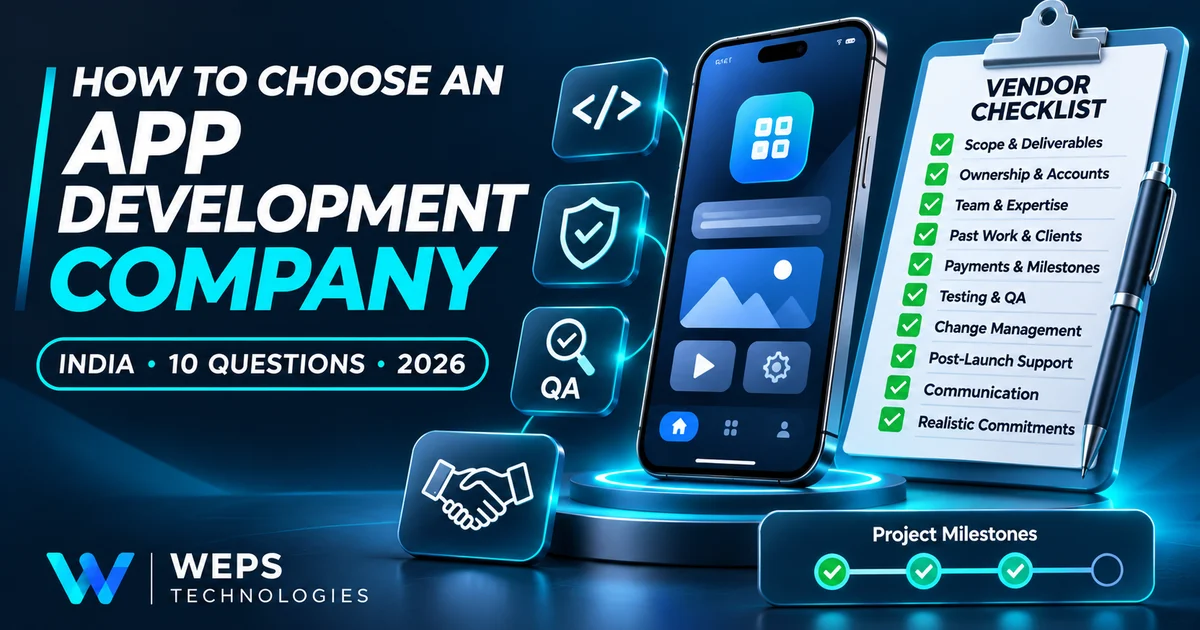
Quick answer: To choose an app development company in India, send the same one-page brief to each shortlisted team and ask ten questions about scope and acceptance, code and account ownership, the people doing the work, relevant proof, payment milestones, quality testing, change requests, post-launch support, communication, and realistic commitments. Compare their written evidence, not only the lowest quotation or the most polished presentation. Use the scorecard below before paying an advance.
Choosing a development partner can be difficult when every proposal says “end-to-end development,” “best quality” and “on-time delivery.” Those phrases are not evidence. A better selection process gives you a testable scope, identifiable owners and a way to spot missing work before it becomes a paid change.
This guide is for founders, startups and businesses commissioning an Android, iOS or cross-platform app. It is a buyer's checklist—not a ranking of agencies or a promise that any hiring process eliminates risk. If you need to estimate budget first, read our app development cost guide. If the idea is not scoped yet, use our app planning guide.
Before contacting an agency: create a one-page app brief
A company cannot price the same product as another company if your brief is ambiguous. Start with these seven details:
| Brief field | What to write | Simple example |
|---|---|---|
| Target users | Who uses the app and why | Delivery staff recording proof of delivery |
| Core outcome | One task that must work in version 1 | Capture signature and upload a delivery record |
| Platforms | Android, iOS or both; initial priority | Android first; iOS considered later |
| First-release scope | Must-have features and explicit exclusions | Login, scan, offline queue; no rewards program |
| Existing assets | APIs, designs, brand, backend or content | Existing REST API, no admin panel |
| Integrations | Payments, maps, SMS, devices, analytics | Maps and SMS; vendors not yet selected |
| Constraints | Deadline, security needs, approver | Pilot date and named product owner |
Send one unchanged brief to every shortlisted team. Ask them to respond with assumptions, exclusions, a proposed delivery plan and a cost breakdown. This is the simplest way to make quotations comparable.
The 10 questions to ask an app development company
1. What exactly will you build, and how will we accept it?
Request a written scope that names platforms, user roles, screens, functions, backend responsibilities and integrations. It should distinguish included, excluded, and dependent on third parties. Ask for acceptance criteria before the contract is signed.
For example, “offline upload supported” is vague. A useful acceptance statement might read: "A saved delivery record remains on the device without connectivity, enters the upload queue when a connection returns, and is not shown as submitted until the server confirms receipt." The specific rule should match your actual business process.
Evidence to request: feature list, user journeys, assumptions, milestones and sample acceptance criteria. Red flag: “Complete app” with no written definition of finished work.
2. Who owns the code, designs, cloud services and app-store accounts?
Clarify who controls the Git repository, signing materials, Play Console or App Store Connect, analytics, domains, hosting, databases and third-party billing. Set out whether custom code is assigned to you, licensed to you, or partly based on pre-existing vendor components. Include third-party and open-source licence disclosures in handover. On Apple's side, the legal entity enrolled in the Apple Developer Program is the seller shown on the App Store, so enrol in your own business's name, not the agency's.
Do not assume that paying an invoice automatically transfers every intellectual-property right. Under India's Copyright Act, ownership and assignment involve legal rules and written terms; the contract should specify the rights you receive. Have an appropriate lawyer review high-value IP terms. Google Play has a formal transfer process for apps, but transferring later can be avoidable work. Sources: Copyright Act, 1957, sections 17 and 19 and Google Play app transfer.
Evidence to request: account ownership table, source-code delivery format, IP/licence clause, credential handover procedure and exit terms. Red flag: the vendor cannot explain how you would continue with another developer.
3. Who will actually design, develop, test and manage the project?
Ask who owns product decisions, design, mobile development, backend work, QA and release. A smaller project may have people covering multiple roles; that can be reasonable if responsibilities and capacity are clear. Ask who will attend reviews and who takes responsibility when there is a blocker.
Subcontracting is not necessarily a problem. Undisclosed subcontracting with no accountable owner is. Request the escalation contact and a policy for access to your customer data and repositories.
Evidence to request: named project lead, role coverage, review cadence and escalation route. Red flag: the sales representative is the only person you can identify.
4. What comparable work can you demonstrate—and what was your role?
Install live apps where possible. Ask which features the vendor actually built, whether they can demonstrate a relevant workflow, and how you can verify the work without breaching a client's confidentiality. A demo, anonymised architecture walkthrough, redacted case study or permission-based customer reference can be useful alternatives to public client details.
Look past download counts and star ratings: they may not measure the vendor's delivery quality, and the vendor may not have built every part of a listed app. A new specialist team may have good expertise without a large public portfolio; evaluate verifiable capability, not a rigid count of apps.
Evidence to request: attributable project examples, working demonstration, technical explanation and a permitted reference. Red flag: repeated claims that cannot be tied to any deliverable or accountable team.
5. How are the quotation and payments connected to deliverables?
Ask for a breakdown of discovery, UI/UX, Android, iOS, backend, integrations, QA, release and post-launch support. Distinguish fixed price, time-and-materials, third-party usage charges and items not covered. No payment model is always best; the right one depends on scope certainty and how changes will be approved.
Milestone examples include an approved functional specification, signed-off design, tested feature set, release candidate and production handover. Define what evidence unlocks each payment, what happens when an acceptance test fails, and how cancellation or delays affect charges.
Evidence to request: itemised quotation, milestone acceptance gates, taxes and payment terms. Red flag: the quote includes everything but never states what is excluded.
6. How do you test the app, and what proof will I receive?
Ask for a test strategy covering device and OS versions, different network conditions, crashes, accessibility, security, permissions, login, notifications, payments and offline behaviour where applicable. The test plan must match your features—not be a generic 100-item form that nobody runs.
Ask for periodic test builds, a shared defect tracker, severity definitions and sign-off criteria. For apps with sensitive data, discuss secure access, backups, privacy requirements and how incidents will be handled.
Evidence to request: supported-device matrix, sample QA report, staging build and bug-resolution workflow. Red flag: “tested by developers” with no test cases, device coverage or acceptance evidence.
7. How do scope changes affect the cost and delivery date?
Scope changes are normal; unrecorded changes are expensive. A good change request documents the new requirement, why it is needed, the estimate, the delivery impact and the person authorised to approve it. Critical bugs in agreed scope should not automatically be treated as paid features.
Evidence to request: change-request template, decision log and the distinction between a defect and a new feature. Red flag: unlimited changes with no explanation of what unlimited means.
8. What happens after launch, and what does support include?
App-store approval is not the same as a maintenance plan. Ask who monitors crashes and failed transactions, responds to store policy or OS changes, updates dependencies, renews services and handles urgent defects. Define the warranty period, response channels, incident severity, support hours and separate prices for enhancements.
For Google Play publishing, the client and developer should agree on account verification, test eligibility, privacy disclosures and release responsibility before the launch milestone. See our Google Play publishing checklist.
Evidence to request: maintenance scope, support SLA or response targets, ownership of recurring subscriptions and handover documentation. Red flag: launch happens, then nobody owns the next update.
9. How will I see progress and make decisions during development?
Choose a named point of contact and a review rhythm that fits the project. Weekly demos or milestone reviews are useful when they include working builds, decisions, open risks, blockers and the next actions. Use a shared issue board and agree who can approve scope, design or release changes on your side.
Evidence to request: sample weekly status report, demo cadence, issue board and decision escalation process. Red flag: prolonged silence followed by a final build you cannot influence.
10. Which outcomes will you not guarantee?
A trustworthy partner can explain uncertainty. No supplier controls app-store approval outcomes, future downloads, rankings or every external API and provider. Ask how they will mitigate these dependencies, what they can commit to, and which conditions would change the schedule or cost.
Evidence to request: project risks and assumptions, dependencies and realistic release criteria. Red flag: guaranteed store approval, viral growth, fixed revenue or a final date regardless of unresolved scope.
Compare three app development companies with a practical scorecard
Use the same questions and the same standards for every vendor. The following weights are an illustrative decision aid, not an industry-certified score. Rate each response from 0 to 5: 0 = no answer, 1 = unsupported claim, 3 = written answer with partial evidence, 5 = clear written answer supported by relevant evidence. Calculate weighted points as (rating ÷ 5) × weight.
| Criterion | Weight out of 100 | What strong evidence looks like |
|---|---|---|
| Written scope and acceptance | 15 | Screens, exclusions, testable done criteria |
| IP rights and account control | 15 | Clear ownership/licence and exit terms |
| Team accountability | 10 | Named roles and escalation contact |
| Demonstrated relevant work | 10 | Verifiable demo and contribution |
| Payment transparency | 10 | Breakdown, conditions and milestones |
| Testing and security | 15 | Device matrix, QA evidence and risk plan |
| Change management | 5 | Written approval and pricing process |
| Maintenance and support | 10 | Warranty, support coverage and costs |
| Communication and delivery visibility | 5 | Demos, issue board and status cadence |
| Honest dependencies and commitments | 5 | Explicit assumptions and risks |
| Total | 100 | Score after examining evidence |
A total score is not a substitute for judgment. For example, unresolved ownership of production accounts or an unacceptable privacy risk may be a deal-breaker even if a vendor scores well elsewhere. Don't assign scores from promises alone.
Seven warning signs before signing
Watch for a quotation without a meaningful scope; vague source-code or account access; “guaranteed downloads” or store approval; large payments with no acceptance rules; no explanation of QA; undisclosed third-party subscriptions; and no written exit/handover process. A single warning is a question to investigate, not proof that the supplier is fraudulent.
What your app development agreement should cover
Before signing, check for statement of work, exclusions, milestone evidence, approval authority, payment and tax terms, IP assignment or licence terms, third-party and open-source components, confidentiality and data handling, security and breach escalation, warranty and maintenance, change orders, termination, dispute handling, and a complete exit/handover plan. Ask a legal professional to review contracts that carry material IP, data, regulatory or financial risk.
For the final handover, request the agreed repository, build and release instructions, environment variables handed over through a secure channel, infrastructure inventory, store access, signing and backup procedures, API documentation, dependency licences and unresolved known issues. Never publish secrets in an ordinary project handover document.
A message you can send to shortlisted companies
Copy this, fill in the brackets, and send it with your brief:
- We are comparing mobile app development partners for [brief description].
- Please respond to the attached one-page brief with your proposed platforms and delivery scope, assumptions and exclusions.
- Please include your team and project lead, relevant work examples, estimated stages and testing plan.
- Please include an itemised cost with payment milestones, ownership and handover terms, and post-launch support.
- Please identify any third-party services or store requirements that could affect the budget or timeline.
- We will compare written responses using the same criteria.
Need a way to prepare the first-release scope? Start with our application planning guide. For technology choices, see native Android vs Flutter. Hiring for a website instead? Read how to choose a website development company in India and our website quotation checklist. A more detailed build schedule is in how long it takes to develop a mobile app.
Frequently asked questions
How do I choose the best mobile app development company in India?
Write a short project brief and compare at least two or three suitable teams using written evidence of delivery scope, ownership, relevant work, testing, payment terms and support. The best fit depends on your product, risk and budget—not a generic ranking.
What should I ask before paying an app developer?
Ask for deliverables and acceptance criteria, a payment schedule, your rights to the finished work, developer and cloud account ownership, a testing plan, change-control rules and post-launch support responsibilities.
Who owns the source code after I pay a developer?
It depends on the contract and applicable law. An invoice alone is not a complete IP agreement. Specify custom-code assignment or licensing, third-party components and access rights in writing, and get legal review for material projects.
Should I choose a freelancer or a development company?
A freelancer can work well for a well-scoped app, while a company may offer a broader team and continuity. Apply the same questions about capability, accountability, testing, handover and support to both.
How can I verify an app development company's portfolio?
Install or view working apps, ask for the vendor's precise role, request a relevant demo, discuss the technical trade-offs and check client references where consent permits. Store ratings alone are not proof of the agency's role.
Can anyone guarantee Google Play or App Store approval?
No. The store owner makes review and policy decisions. Developers can prepare submissions carefully and respond to issues, but they cannot guarantee an outcome or review date.
How much advance payment is reasonable?
There is no universal percentage. Evaluate the project size, engagement model, documented milestones and exit terms. A manageable advance with written deliverables is usually easier to assess than an unexplained full upfront payment.
Discuss your app with Weps Technologies
At Weps Technologies, our mobile application development service covers planning, Android, iOS and cross-platform choices, testing and release support based on the project scope. If you are comparing vendors, send us the same one-page brief and ten questions you would send to anyone else. We can discuss the scope and explain our proposed approach without promising rankings, downloads or store approval. Our published apps are Android apps; we will say plainly if your project needs something we have not built before.
Contact Weps Technologies, or call or WhatsApp +91 97193 25253. Please don't send passwords, private credentials or confidential production data in an enquiry form.
If you're deciding whether to build an app at all, see website vs mobile app for a small business.
Sources and editorial notes
- Government of India: Copyright Act, 1957, sections 17 to 19: the author is the first owner subject to the Act, and an assignment must be in writing and signed. Contract interpretation can need professional advice.
- Google Play Console Help: Transfer apps to a different developer account: a formal transfer process exists when needed.
- Apple Developer: Program enrollment: individual and organization enrollment differ, and the enrolled legal entity is the seller.
Sources were checked on 18 November 2026 and can change. This article is a purchasing checklist, not legal advice. Verify current platform policies before signing or launching.