
Mobile Apps
MVP App Development in India: What to Build First and What to Cut
Weps Technologies · 22/11/2026 · Updated 22/11/2026
An MVP is not merely a small app. Learn how to define its core job, choose must-have features, test assumptions with real users, and decide what to build next.
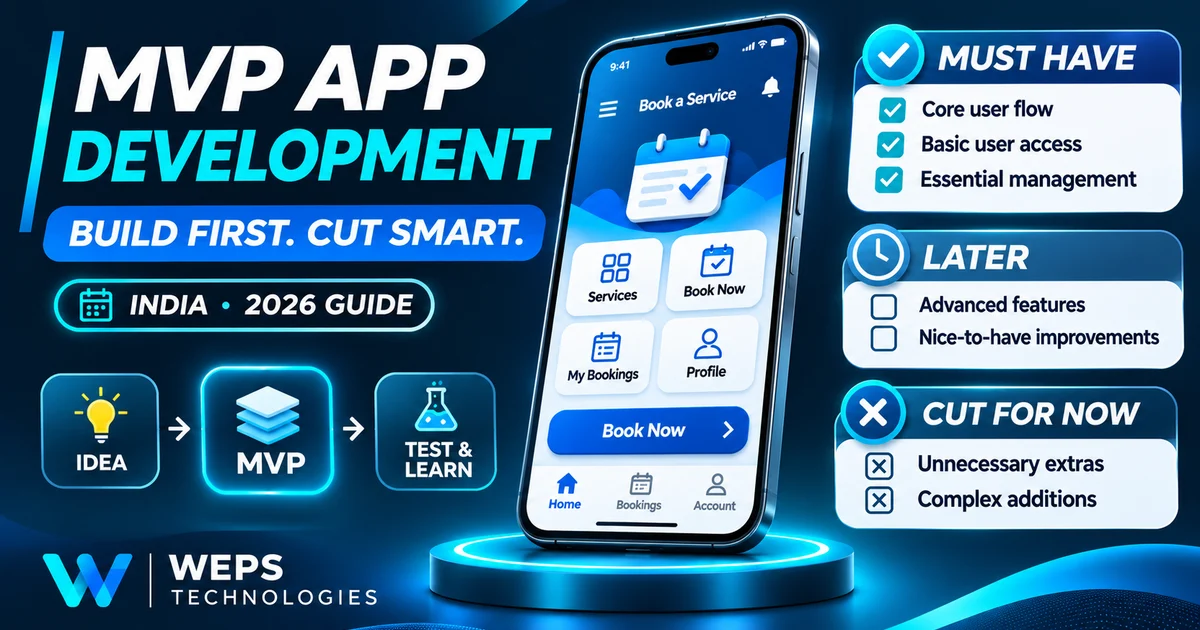
Quick answer: An MVP, or minimum viable product, is the smallest useful test of a product idea that helps a team learn from real customers with limited effort. For a mobile app, that often means a reliable first version that completes one important user task—without the expensive extras. Start by writing the user's main job, identifying the assumption you need to test, choosing only essential features, and defining what successful usage would look like. Keep testing, security, clear feedback, and a way to learn from users. Put everything else in a deliberately managed backlog.
If you are still defining your requirements, start with our application planning checklist. If your biggest question is the likely budget, read our app development cost guide for India.
What is an MVP in app development?
MVP stands for minimum viable product. Eric Ries defines it around gaining validated learning about customers with the least effort. That last part matters: shipping fewer features is useful only if the release helps you test whether people need the product and can use it.
An MVP is not permission to ship a broken app. It also does not need to automate everything. Some early product assumptions can be tested with a simple landing page, a clickable prototype, a concierge or manual workflow, or a limited working app. Choose the smallest honest test appropriate to the question; do not present an unbuilt feature as if it already exists.
For a customer-facing app MVP, the core flow should be usable, stable enough for the target test, and transparent about what is still manual or limited. The definition above is from Eric Ries's original MVP explanation.
| Approach | What it primarily proves | What a user actually gets |
|---|---|---|
| Concept or landing-page test | Whether the problem and proposition attract interest | Information, an invitation, or a transparent waitlist |
| Clickable prototype | Whether people understand a proposed flow | Simulated interactions, usually without production data |
| Concierge or manually operated MVP | Whether the outcome is useful before automating it | A real service, supported by humans behind the scenes |
| Working mobile-app MVP | Whether users can complete a core task repeatedly | A narrow but functional mobile experience |
| Full product | Whether an expanded, sustainable product can operate at scale | Broader features, integrations, and operational coverage |
The goal is learning—not merely launching. A small release without a learning question can still waste money.
Step 1: Define the user, the job, and the assumption
Write the problem without mentioning a technology or a feature list:
A [specific user] needs to [complete one task] when [situation], but today [pain or workaround].
Examples below are hypothetical, not WEPS client case studies:
- A delivery rider needs to record proof of delivery without a network connection, but paper forms are difficult to reconcile later.
- A salon customer wants to reserve an available appointment without calling during opening hours.
- A shop manager needs to confirm today's orders without jumping between multiple spreadsheets.
Now add the risky assumption. For a salon product it might be: Customers will independently book a slot from their phone and arrive at the agreed time. A nice-looking calendar does not prove that assumption. Completed bookings do.
For each idea, write down four inputs: user, core job, risky assumption, and success signal. Our broader app planning guide helps you capture the rest of the brief.
Step 2: Map the smallest complete user journey
An MVP must cover the full route from intention to result. Draw the journey in one line:
Discover/enter → take the main action → receive clear confirmation → recover from failure.
For the hypothetical salon app, that might mean: view services, choose an available time, provide only necessary contact information, confirm the appointment, and receive a clear booking reference. The owner must also have a workable way to accept or manage the booking—this could be a basic admin screen or a documented manual process.
Do not omit loading states, invalid inputs, error messages, retry behaviour, or support contact information. These may be unglamorous, but they determine whether a real user can finish the task.
A simple MVP acceptance test
Before development, agree on a sentence such as: A new customer can book one available appointment on a supported phone and receive confirmation, while the owner can find and manage that booking; if the network fails, the app explains what happened and avoids creating duplicate bookings.
That is much clearer than “build a complete salon booking app.”
Step 3: Sort features into Must Have, Later, and Cut for Now
Use three buckets. Must Have means the core outcome—or an essential safety, legal, operational, or accessibility requirement—fails without it. Later means valuable but not necessary for the learning goal. Cut for Now means it has no convincing reason to be in this experiment.
| Feature question | Must Have when… | Often Later when… |
|---|---|---|
| User sign-in | Identity or secure access is genuinely needed | Guest use or a simpler identifier can work safely |
| Booking / order / core action | It is the product's main task | Never defer the entire primary task |
| Payment processing | Payment is inseparable from the tested transaction | Manual invoicing or pay-at-location works for this test |
| Push notifications | Timely alerts are essential to the outcome | Email, an on-screen status, or manual follow-up suffices |
| Admin operations | Staff cannot deliver the promised service otherwise | A documented spreadsheet workflow works at small scale |
| Multiple languages | The target users cannot use the product in the first language | Your pilot group is comfortable with one language |
| AI recommendations | AI itself is the core value being tested | A fixed list or manual recommendation is adequate |
| Reviews, loyalty, referrals | They are central to the core hypothesis | They are growth ideas rather than MVP necessities |
Important nuance: “Can the user finish without it?” is not the only test. A feature may be essential to protect user information, prevent fraud, meet applicable obligations, or let your team fulfil its side of the transaction. Never remove those protections just to make the feature count smaller.
Step 4: Prioritize by evidence, effort, and dependencies
For every proposed feature, ask five questions:
- Does it directly support the core task or required protection? If not, move it out of the MVP.
- What real evidence makes us believe users need it? Distinguish observed problems from guesses.
- Could a simple or manual process test the same assumption? Be open about manual work; never mislead users.
- Does it depend on unavailable data, approvals, payments, or integrations? A small feature can be a major delivery dependency.
- How will we know whether it worked? Choose an observable event, not an impression.
Keep a written record for each decision. A vendor should be able to explain not only what is included but why.
MVP features you can often postpone
These are common candidates to defer, not universal rules:
- A simultaneous Android and iOS launch when early users are concentrated on one platform. Consider the user base before choosing; compare native Android and Flutter if shared-code delivery is relevant.
- Referral campaigns, rewards and gamification when the main task is not social sharing.
- Complex dashboards and dozens of reports when one completion metric answers the first business question.
- Advanced personalization and generative AI when a simpler workflow provides the same initial value.
- Many themes, custom animations and deep profile settings that do not change core-task success.
- Multiple roles and permissions beyond the operational minimum, while retaining appropriate access controls for any roles that remain.
A feature in Later is not a promise to build it. Reconsider it when user feedback or measurable demand supports it.
What you must not cut from an MVP
Reliability, privacy, security, accessibility, basic QA, and clear user feedback are quality requirements, not optional polish. Their exact implementation depends on the product and the data involved. At a minimum, define who can access data, what you collect, how failed actions are handled, and what gets tested before the pilot. If the app handles money, health, children, sensitive records, or regulated activities, review the relevant obligations before choosing shortcuts.
The first release also needs ownership clarity: repository access, signing and store accounts if applicable, environment configuration, handover documents, and a known support contact. Skipping handover may be cheap now and expensive later.
Three practical MVP examples (hypothetical)
| Idea | Main job | Initial scope | Consider later | What to measure |
|---|---|---|---|---|
| Delivery proof app | Record a delivery reliably | Capture, consent/signature if needed, offline save, retry/sync, confirmation | Route optimization, rewards, analytics suite | Successful proof records and sync failures |
| Salon booking | Reserve an available appointment | Services, availability, booking, confirmation, owner workflow | Loyalty, ratings, multiple locations | Completed self-service bookings and no-shows |
| Shop order dashboard | View and manage new orders | Order list, status update, simple notification or refresh, failure handling | Inventory forecasting, multi-branch reports | Orders processed without manual reconciliation |
Different businesses have different constraints. None of these examples is a price quote, delivery guarantee, or published WEPS case study.
How to estimate MVP app cost and timeline in India
There is no responsible fixed rupee price or delivery period for an unspecified MVP. A simple-looking app can need complex integrations, offline behaviour, store compliance, or substantial backend work. Conversely, an existing API and clear requirements can reduce effort. Ask for an itemised estimate covering discovery, design, app, backend, testing, release, handover, and support.
For what pushes a budget up or down, see app development cost in India. For schedule assumptions and what affects launch, read how long it takes to build a mobile app.
Do not compare two MVP quotes until the scope and acceptance criteria match. One vendor may price only screens, while another includes operations, QA and store submission.
How to measure whether your MVP actually works
An MVP is successful when it helps you make a better product decision, not merely when it appears in an app store. Pick one primary learning metric and a few quality guardrails before inviting pilot users.
| Metric | Practical meaning | Example observation |
|---|---|---|
| Activation / core-task completion | Users who finish the main job | Bookings confirmed ÷ people who began booking |
| Time to complete | Effort to get the intended outcome | Time from choosing a service to seeing confirmation |
| Repeat use | Whether users return when the job occurs again | Customers who complete another eligible booking |
| Failure / support rate | Where the experience breaks | Failed syncs, duplicate orders, help requests |
| Qualitative feedback | Why users behave as they do | Recorded interviews or categorized feedback |
Set a pilot window and a decision rule that match your product and available users. For example, a team could plan to observe its first small group of eligible customers, compare completion and support issues against a predefined target, and decide whether to iterate, change the flow, or expand scope. Any numbers or thresholds should be chosen from your circumstances—do not invent a universal “good MVP conversion rate.”
The Build–Measure–Learn loop
Build the smallest credible test → Measure actual behavior and user feedback → Learn whether the assumption held → Decide to improve, simplify, change direction, or scale. Repeat intentionally. This learning loop is the reason the MVP exists.
What to send an app development company
Give every shortlisted developer the same short document:
- User persona, problem and core-task sentence.
- Key risky assumption and the evidence currently available.
- Must Have / Later / Cut-for-Now feature lists.
- Main flow, edge cases, and an acceptance test for each essential feature.
- Required platforms, integrations, test devices, and data/privacy constraints.
- Who provides APIs, content, developer accounts, and day-to-day approvals.
- Pilot learning metric, timeline expectation, and handover/support needs.
Request a written scope with explicit exclusions, a change-control process, named responsibilities, milestone-linked deliverables, and agreed ownership/licensing terms. Our 10-question app development company checklist covers vendor evidence and contracts.
Frequently asked questions
What does MVP mean in mobile app development?
A minimum viable product is the smallest version or test that helps a team validate an important customer or product assumption with limited effort. For many mobile products, this is a focused app that completes one useful task reliably.
Is an MVP the same as a prototype?
Not necessarily. A prototype mainly explores usability or design, whereas an MVP is designed to produce learning about real customer value. Depending on the hypothesis, an MVP may be a working app or a transparent manual-service experiment.
Which features belong in an MVP app?
Include the primary user journey and whatever operational, privacy, safety, accessibility, testing, or measurement capabilities are needed to deliver and evaluate it responsibly. Postpone features whose value is still speculative.
Should an MVP be Android, iOS, or Flutter?
Choose based on where your first users are, your critical device capabilities, budget, team and long-term maintenance needs. A single-platform pilot may reduce initial scope; cross-platform development can be sensible when both audiences are important.
How much does MVP app development cost in India?
Cost depends on the defined features, platforms, integrations, design, backend, QA and support. Ask for an itemised scoped estimate rather than relying on one generic price.
How long does it take to launch an MVP?
It depends on readiness and scope. Discovery, approvals, backend work, testing and distribution can all affect schedule. Get a milestone plan with assumptions and external dependencies.
Can I add more features after launch?
Yes—but use actual behavior, support issues and pilot learning to decide which features deserve the next iteration, instead of automatically building the full original wish list.
Can I skip testing or security for version one?
No. A limited feature set still needs reliable behavior and reasonable safeguards. The required checks depend on what the app does and what data it processes.
Plan your MVP with Weps Technologies
If you are considering a first Android product, bring us your core job, assumptions, and Must Have / Later / Cut-for-Now lists. We can help turn them into a practical scope and an itemised estimate—not a promise of downloads, revenue or store approval. Explore our mobile application development service, or share the brief using the contact form. You can also call or WhatsApp +91 97193 25253. Our published apps are Android apps, and we will say so if your project needs something we have not built before. Please do not send passwords, OTPs, or payment-card details.
Sources
- Eric Ries, Lean Startup Co.: What Is an MVP?: the definition around validated learning about customers with the least effort.
Editorial note: The comparison of approaches (landing page, prototype, concierge, working app) and all examples are our own practical guidance and are hypothetical, not WEPS client work. This article is product-planning advice, not an engineering quotation, legal opinion, or a guarantee of launch results.